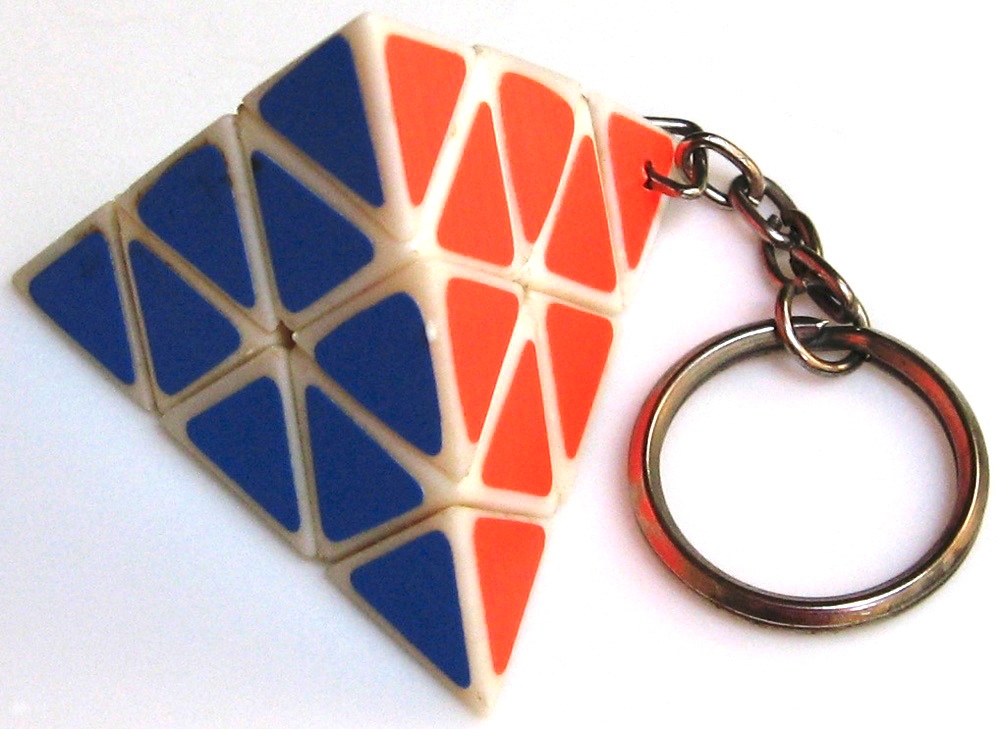
Pyraminx
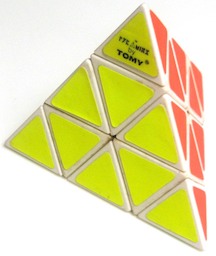
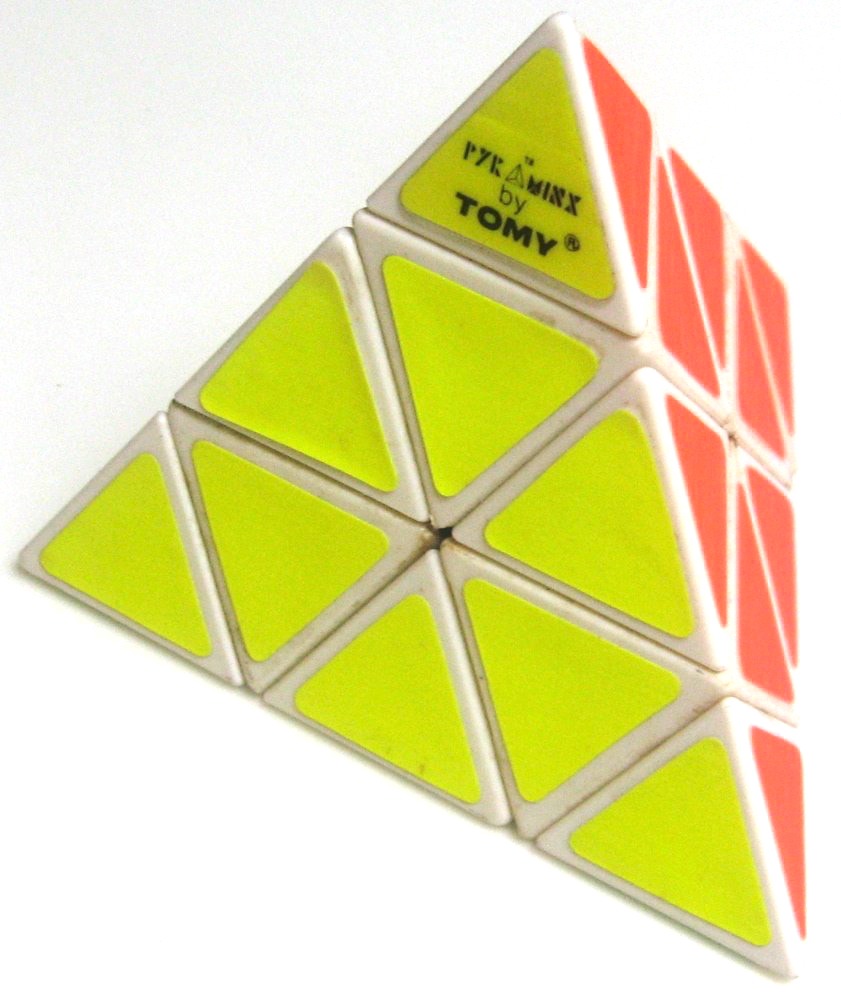
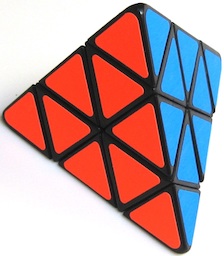
Tomy Pyraminx, Patented by Meffert 1981 and Copyright by Tomy 1981;
(back blue, bottom green, 4" along an edge;;
see also Mefferts
Jing's Version
of this puzzle)
Notation:
There are
4 tips,
4 corners that the tips are attached to,
and 6 edges.
Holding the puzzle with one of the faces towards you,
clockwise and counterclockwise rotations of the top, lower left, and lower right corners are denoted by
T+, T-, L+, L-, R+, and R-.
An Edges First Solution:
1. Orient the tips (and to stay organized, keep them correct after each step).
2. Place the bottom edges
(easy when you don't care about the corners).
3. Rotate the top so that at least one of the three remaining edges is correct,
and position the puzzle so that this correct edge is in back.
4. The two front edges will now be in position; if they are flipped, do:
R- T- L- T+ L+ R+ T+
Note:
Memorize
+++--- with a twist"
The "twist" is that T is in the middle of the -'s and first of the +'s.
No need to remember the final T+, that will be obvious.
5. Correct two corners at a time with simple 5-sequences that rotate the two front corners,
where here x and y are each either + or -, and 5 means repeat five times:
(Lx Ry)5
Choose + and - to be
opposite
the direction you want to go.
For example,
do L- R+ five times to rotate the front left clockwise
(60 degrees)
and the front right counter-clockwise.
(to correct a single corner,
make it and an adjacent corner
incorrect
and then use a second 5-sequence to correct the two).
Number of Moves Used By the Edges First Solution
If Step 1 is skipped, then after completing Step 2,
Step 3 is 1 move, Step 4 is 7 moves, Step 5 is 10 moves to correct two corners or 20 moves to correct 1, 3, or 4 corners,
and finally correcting the tips is 3 moves, for a total of 31 moves in addition to Step 2.
This is far more than used by an optimal algorithm
(Jaap's Page
describes a computer analysis that shows that a solution is always possible in at most 11 moves).
However, it is a simple method that amounts to memorizing the sequence of 7 moves for Step 4.
Also, if one is careful to choose the easiest face for the bottom and minimize the number of moves for Step 2,
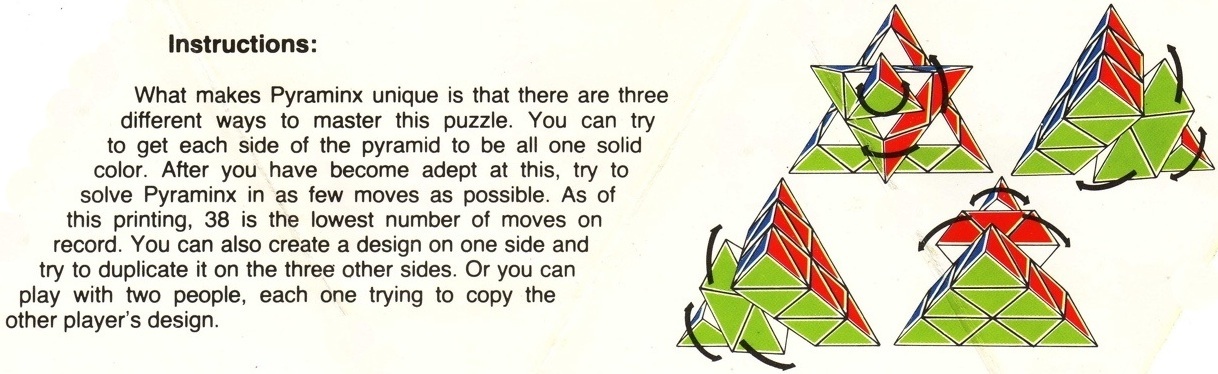
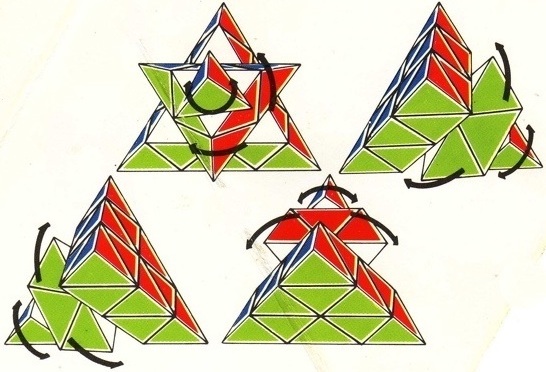
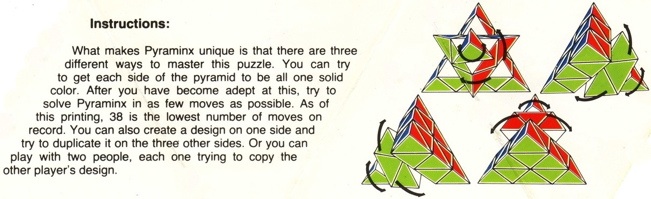
the solution compares well with the total of 38 moves mentioned in the directions to the original Tomy version:

A Corners First Solution
A corners first solution may use fewer moves but is harder to remember;
we use the same notation as for the edges first solution:
1.
Orient the tips to match their corners.
2.
Orient the corners to be correct.
3.
Solve the top three edges using ++-- or --++ on adjacent corners.
These transformations leave the corners solved, do not disturb two of the top edges,
and permute the other edges.
With practice it is pretty easy to get the top pyramid of the puzzle solved.
4.
Turn the puzzle so that the face with the unsolved three edges faces you.
Use these two transformations cycle the three edges clockwise or counter clockwise until the puzzle is solved,
or all that is left is to flip the two upper front edges:
T- R T R-
T L- T- L
5.
If the two upper front edges need to be flipped,
we are now in the same situation as Step 4 of the corners first solution,
except use a more complicated transformation that does not disturb the corners:
R T- R- T R- L R L-
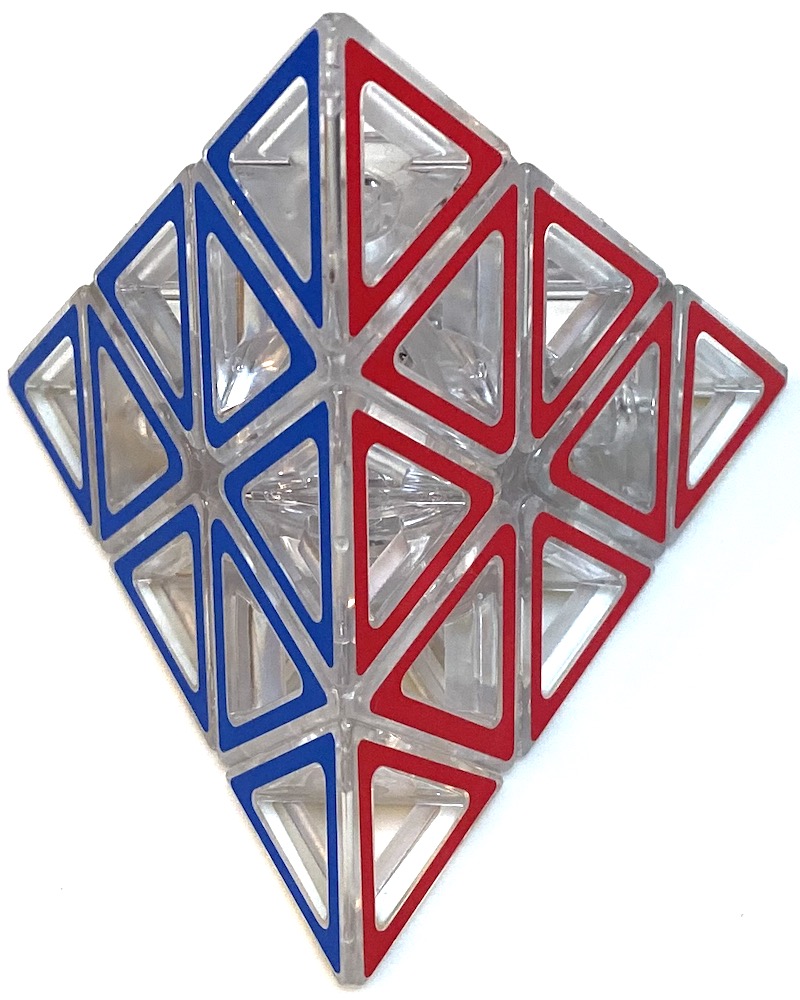
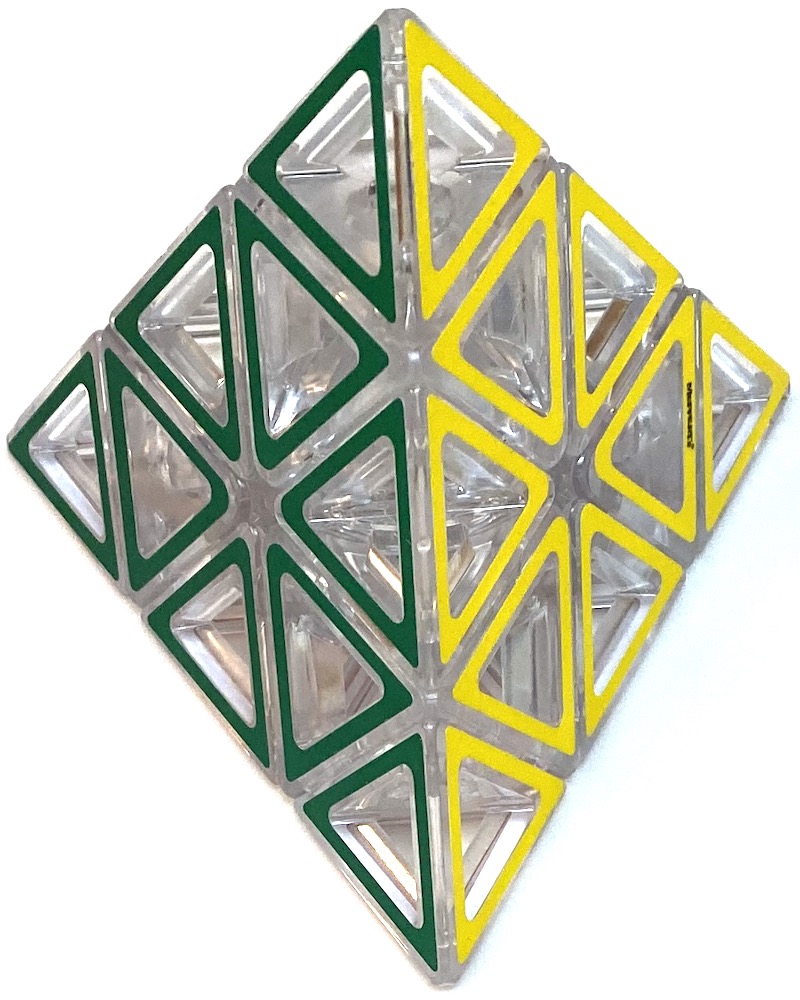
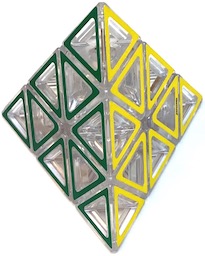
Crystal Pyraminx
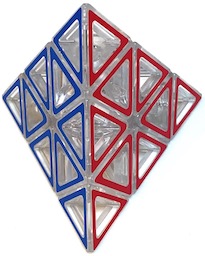
a.k.a. Hollow Pyraminx
Sold by Mefferts to celebrate its 50th Anniversary, 2019.
(plastic, 4" along an edge)
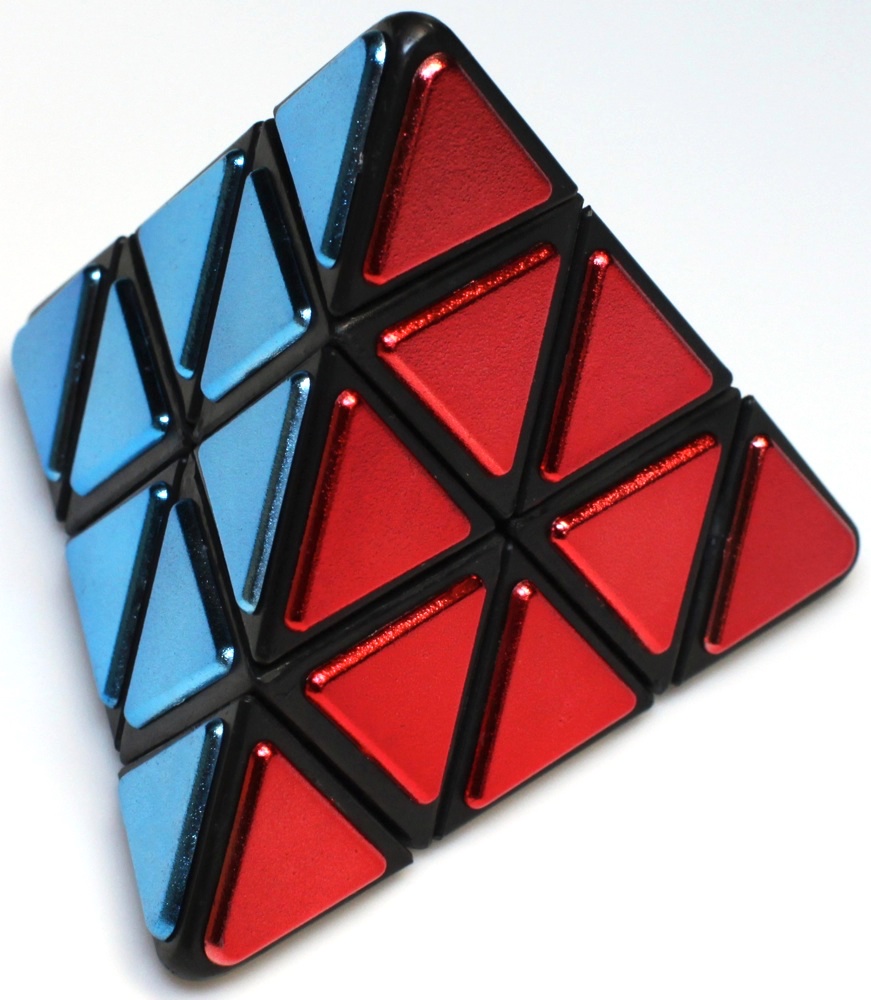
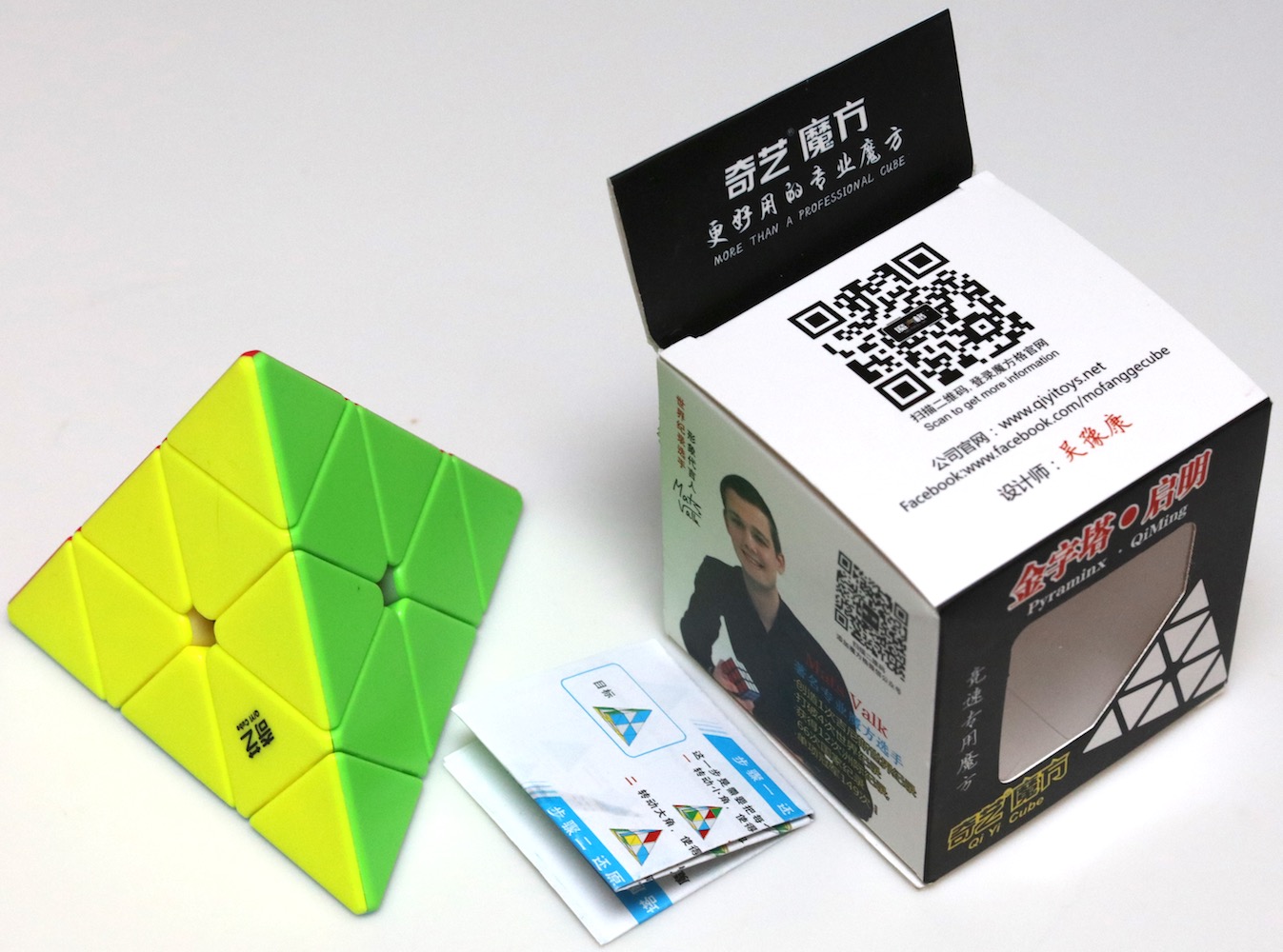
Other Versions of Pyraminx
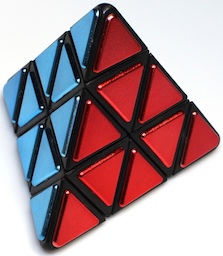
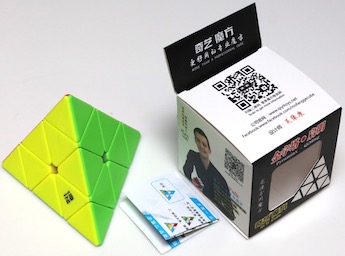

up-left: metalized surfaced with click stops, 4" on an edge, Mefferts 2006;
up-right: D-FantiX Qiyi Qiming Stickerless, 4" on an edge, Amazon.com 2017;
down-left: plastic 4" on an edge, Mefferts 2006;
down-right: right plastic with chain, 1.75" on an edge.
Further Reading:
Mefferts Page,
from: http://www.mefferts.com/puzzles/pyramsol.html
Jaap's Page,
from: http://www.jaapsch.net/puzzles/pyraminx.htm
Ruwix Page,
from: https://ruwix.com/twisty-puzzles/pyraminx-triangle-rubiks-cube
McFarren's Page,
from: http://www.geocities.com/abcmcfarren/math/PyrMin.htm
Dry Erase Board Page,
from: http://www.thedryeraseboard.com/mechpuz/pyraminx/solution
Nerd Paradise,
from: http://www.nerdparadise.com/puzzles/pyraminx
Monroe's Page,
from: http://www.alchemistmatt.com/cube/pyramix.html
Meffert Europena Patent, EP042695A2.